

When Did Direct Instruction Become a Dirty Word?
Why teaching still belongs at the center of the classroom.

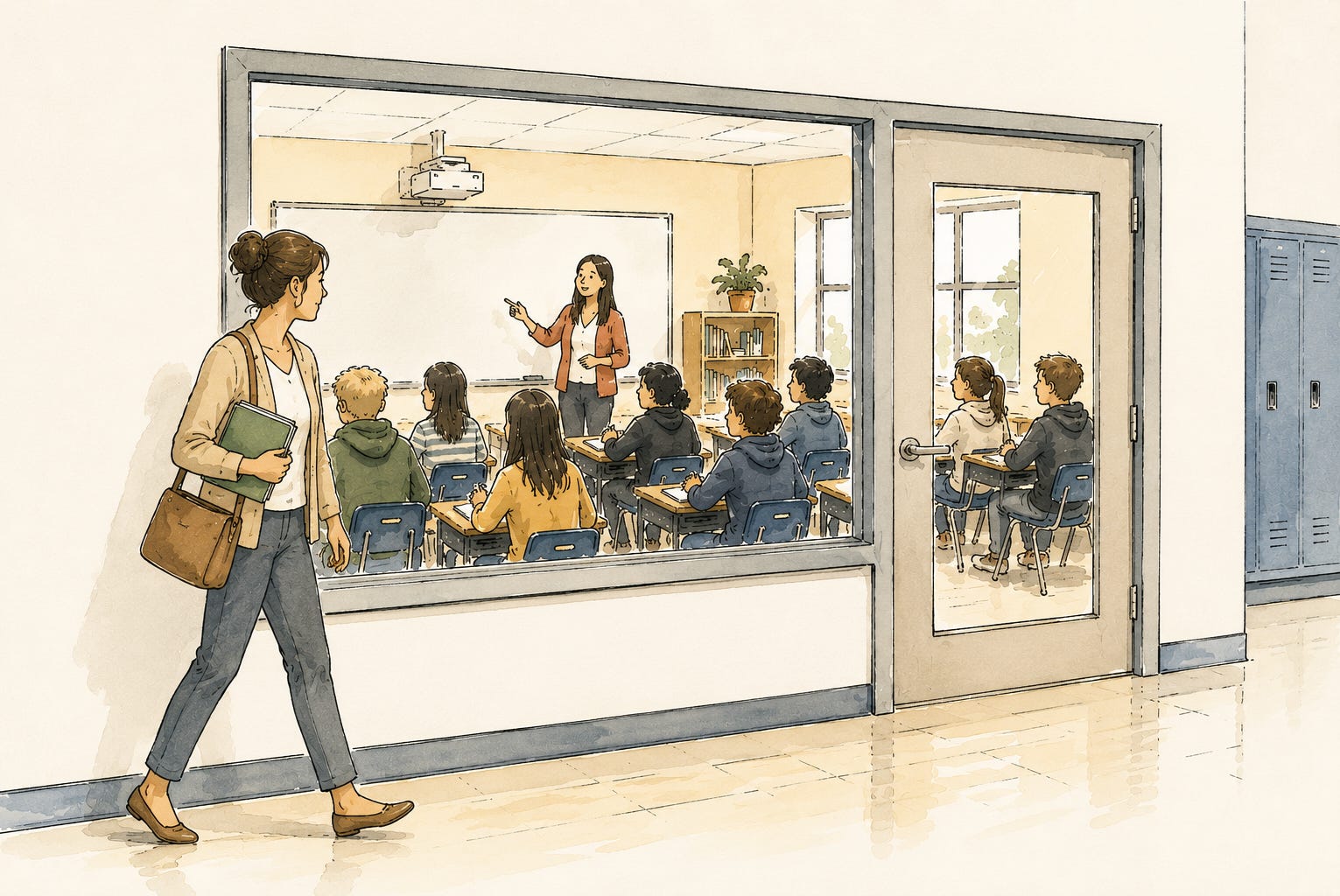
My classroom door has a large glass window, so anyone walking down the hallway can see straight in. Most days, I am at the front of the room teaching my seventh graders: explaining a concept, reading a passage aloud, modeling a skill, or leading a discussion.
The window works both ways (as windows do), so while I am teaching, out of the corner of my eye, I can always see any educator who walks past my classroom. As they go by, they turn their heads briefly to look in (human nature, how could you not), and I imagine the same question behind every glance.
Does she ever do anything besides direct instruction?
Mind you, it never stops me from teaching the way I know works, but I will admit that the question gets to me more than it should.
But to answer the imaginary question running through this hypothetical colleague’s head, the short answer is yes. I teach all kinds of ways. The longer answer is that I lean heavily on direct instruction before moving on to anything else.
Yes, I said that last part out loud. To some educators, that sentence sounds almost heretical. I am not exaggerating. That is the level of judgment direct instruction has reached in education today.
So if no one else is going to ask, I will. How did one of the most powerful ways to teach end up with such a bad reputation?
You might expect a reputation this bad to have a complicated story behind it. It does not. The trouble starts at the doorway. A lesson can be judged in the few seconds someone glances in, not by what students are learning, but by what they look like they are doing.
That judgment runs on a simple assumption: the more the students appear to be doing, the better the teaching must be. Look into a classroom and see students rotating through stations, posting sticky notes on chart paper, talking in groups, and the lesson gets filed under innovative, engaging, and student-centered. Whether anyone in those groups has actually learned something is beside the point.
The room looks busy, and busy reads as good.
Look into the room next door and see an educator at the front explaining, modeling, questioning, and guiding, and that lesson gets filed under less sophisticated, less current, less impressive.
The reflex to make a snap judgment about a lesson, often a wrong one, feels automatic, but it was drilled into us. Educators did not wake up one morning and decide direct instruction was old-fashioned.
We were told that.
We heard it in educator preparation programs, in professional development sessions, at conferences, in books, workshops, and staff meetings. We were told that students should be doing the work, that the educator should step aside, and that less direct instruction was the mark of better teaching. After enough years of that, it is no wonder so many of us feel the need to justify standing in front of a room and doing our job.
After all these years, you would think I would know what works in my own classroom well enough to stop caring what anyone else thinks. But that old worry about being judged is still buried in the back of my mind, and it surfaced the day the head of our Science department stopped by and said, “Every time I walk past your room, your students are looking directly at you, and they’re listening as if you’re telling them the secret to life. What are you teaching?”
I laughed.
“Trust me, that level of attention didn’t happen by accident,” I replied. “A lot of work goes into deciding what is worth teaching and how to teach it so they actually care.”
Then, before I could stop myself, I added that the students were not always sitting and listening to me. “You just happen to walk by when I’m in front of the room,” I said. “There are plenty of times when they’re working together, discussing ideas, collaborating.”
It was only later that I wondered why I felt the need to say any of that. She had just complimented me. She had simply noticed that my students were paying attention, and my immediate reaction was to reassure her that direct instruction was not all we did.
I wasn’t defending my teaching. I was apologizing for the direct instruction.
Why?
When I started teaching nearly thirty years ago, direct instruction was not something anyone felt obligated to defend. Explaining concepts, modeling thinking, and guiding students through hard material were simply understood to be the job. Nobody assumed educator-led instruction was automatically less engaging or less effective than anything else. Educators taught, students learned, and no one saw the two as being in conflict.
At some point, the language started to change.
Now I hear educators announce, almost proudly, “I don’t lecture,” or “I’m just a facilitator,” or “My classroom is completely student-centered” (as if teaching a child something they could not do an hour ago is somehow not about the student).
Underneath all of it is the same belief: that if you step back, students will discover what they need on their own.
My answer to that is simple. A child can discover plenty, but not what they were never taught to look for. We got so attached to stepping out of the way that some of us talked ourselves out of teaching at all.
Direct instruction might be the most misunderstood phrase in education. The moment people hear it, they picture an educator droning at the front of the room while students take notes and wait for the bell.
That is not what I mean.
I mean explaining content, modeling thinking, demonstrating skills, checking for understanding, and guiding students through material they could not get through on their own.
In my classroom, that might mean leading a discussion about a novel, showing students how to use commas correctly, modeling how to find evidence in a text, pushing them to think harder about a character’s motivations, or helping them notice a theme they would have walked right past.
The details change. The purpose does not. I am teaching them things they do not yet know and showing them skills they have not yet learned. Often, I am getting them invested in a book they never would have picked up themselves.
What frustrates me is the assumption that direct instruction is the easy option, as though standing in front of a class and teaching takes less skill, thought, and preparation than anything else.
The opposite is true. Good direct instruction requires a hundred decisions before a lesson ever begins. What is most worth teaching? What do students need to know first before any of this makes sense? What will they misunderstand, and how do I get ahead of it? How do I explain something complicated without flattening it into something false? None of that happens by accident. It is the product of preparation, judgment, and years of figuring out what actually lands. That is not avoiding the work.
That is the work.
Every other field understands this. A piano teacher demonstrates technique before a student performs a piece alone. A coach teaches footwork before expecting a player to use it in a game. Experts teach novices, and no one finds it controversial. They would find it strange if it did not happen.
Education may be the only profession that is uncomfortable with experts acting like experts.
Across my career, I have watched one theory after another arrive, each one certain it has finally cracked the code of how children learn. One year it is inquiry. The next it is collaboration. Then passion projects, then personalized learning, then whatever term is printed on next fall’s PD folder. The label changes.
None of it stays abstract. There is always a new ritual to go with the new theory: turn and talk, stop and jot, entrance tickets, exit tickets, gallery walks. None of them are harmful, exactly. The problem is what they are often for. They give students something to do that does not require me, so the room looks active and everyone can point to the motion as proof that learning is happening. But a class can be busy for the entire period and learn nothing.
The theories keep coming and going. One thing has stayed remarkably consistent - the students. On the surface they are not the same, arriving now with phones in their hands and a pandemic in their past. But underneath, where it counts, they have not changed at all. They need an adult who knows the material and is willing to teach it to them. The trends change every few years. What they need does not.
Here is the part that the trends keep skipping. You cannot inquire your way to a theme when you do not yet know what a theme is. You cannot discover what a symbol means when you do not understand what symbolism is, or analyze a passage when half the words in it are unfamiliar.
A twelve-year-old is not going to stumble onto dramatic irony during a turn and talk.
Someone has to teach students what those things are first, and then how to use them. We complain that students do not know enough, and in the same breath, we make educators feel guilty for teaching at all. The research on explicit instruction backs all of this up, but I do not need a study to tell me what I watch happen every September, when a new class walks in.
A few years ago, I decided to try the approach educators are so often told to use. Instead of guiding students through a challenging poem, I put them in groups, handed out copies, and stepped back to facilitate, which is to say I walked around the room with a clipboard while they floundered. The poem was beautiful and genuinely difficult. The vocabulary was unfamiliar, the themes were complex, and the language demanded careful interpretation.
Looking back, the outcome should not have surprised me.
Students groaned as they moved into groups. They could not find their footing in the language and grew frustrated fast. Conversations stalled. Energy dropped. The room felt defeated.
The problem was not that my students lacked intelligence. The problem was that I had asked them to analyze a poem I had not yet taught them how to read.
When we regrouped, the reviews came in fast.
“Poetry is boring.”
“Poetry is hard.”
“I hate poetry.”
To be fair, I might have said the same.
This is where a lot of the inquiry conversation goes wrong. There is a difference between productive struggle and simply not knowing enough to make sense of what is in front of you. When students have the background and the tools, struggle does real work.
When they do not, struggle is just frustration wearing a more flattering name.
The next time I taught the poem, I did almost everything differently. First, I read it aloud. Then I played a recording. Then I showed them a visual interpretation before we went through it together, line by line. I explained the hard vocabulary, modeled how a reader infers meaning, pointed out the devices, and let them see that I actually loved it.
The room was unrecognizable. Students were asking questions, making observations, and connecting ideas they had not touched on the first time. More to the point, they understood what they were reading. Only then did I put them in groups and ask them to build posters analyzing the poem and pulling the lines that meant something to them.
No groans this time. No complaints. No funeral for poetry. Nothing about the students had changed, and the poem had not gotten any easier overnight. The difference was that I gave them what they needed before I asked them to use it.
That sequence is not unique to poetry. It is what I do before I hand students anything difficult.
I build the floor first.
I read the text aloud, I let them hear it and see it, I walk them through the parts that would otherwise lose them, and I show them how an experienced reader makes sense of it. Only then do I step back and let them work. The independence everyone keeps demanding for students is not where you start. It is what you earn once the floor is under them.
Inquiry has its place. That place is after the teaching, not instead of it. I am not handing them the answer and calling it discovery. I am giving them the tools, then turning them loose on the questions that do not have one right answer. Real inquiry, in any field, is done by experts with deep prior knowledge: the scientist, the critic, the historian. The idea that a novice explores best from a blank slate is exactly backwards. A student who knows what a theme is can argue all day about which one a poem is really about. A student who does not is just guessing and calling it discovery.
There is more at stake here than one lesson. Twelve-year-olds are still deciding what they are good at, what they care about, and what is worth the effort. Push them straight into frustration, and they decide fast. They are out. No thank you to poetry, to analysis, to English itself.
Once a student writes off a subject, you spend years trying to win them back. That is why how I teach something I know will be challenging matters as much as whether I teach it at all. The job is to get them to the hard part without losing them on the way.
The question was never whether students should work without me. The question is whether that can replace teaching. It cannot. Someone still has to teach.
The real classroom is not a laboratory.
It is a room full of students with different abilities, interests, attention spans, and starting points. Some are eager. Some are exhausted. Some are counting the minutes until lunch. Some need a great deal of support, and some need almost none. That is exactly why I have never believed the answer is to step aside and let them sort it out on their own.
Some of the most engaging lessons I have ever taught were direct instruction. Students engage when they understand what is happening, when they feel themselves succeed, when an adult helps something click that was a closed door a minute earlier.
Engagement does not come from avoiding instruction. More often, it comes from instruction done well.
On the last day of school this year, a student raised her hand and said, “One of the things I like most about this class is that I don’t dread coming.”
After thirty years, a line like that still gets me.
She did not say she loved every poem or every essay. She said she did not dread it. Coming from a seventh grader, about English, that is no small thing. It means the subject never turned into something to survive.
None of that happened because I stepped back. It happened because I taught her, day after day, how to read closely and look at characters in relation to the world around them, and because I let her see how much I love literature myself. I modeled the excitement before I ever asked her to feel it, and she caught it. If I had spent that time telling her to turn to a partner and ask what they thought of the chapter, I guarantee she would not have raised her hand on the last day to say what she said.
That is what good direct instruction can do.
Somewhere along the way, direct instruction became a dirty word, but it is time we stopped treating it like one. Students deserve more than one way to learn. They also deserve educators who are willing to teach. The best ones know when to step back and let students wrestle with something on their own, and when to step forward and hand them what they need.
Neither should require an apology.
If teaching from the front of the room is working for your students, you do not owe anyone an apology for it. You owe them the lesson.
Yes, and of course!
Your essay is a beautiful snapshot of what YOUR expert teaching looks like, and you offer a POWERFUL insight--you thought you were being criticized when you were actually being praised. Great writing!!
I urge you to develop the habit of documenting the approval and disapproval that you hear in the hallways of your school, and analyze them to understand what is in the water you are drinking.
We KNOW when, where, and how direct instruction became a "dirty word."
We also know that politicians all over the U.S. are currently writing legislation REQUIRING that reading be taught by direct instruction.
History is the biggest eye roll ever.
How can we strengthen the discipline of education to resist irrational social and political forces? I have a lot of ideas about this; what ideas do you and your readers have? Let's talk!
Thank you Kevin for the restack. I appreciate it.